Sales statistics
Missed call statistics: what unanswered calls cost
Verified missed call statistics: how many business calls get answered, why customers still call, how people treat unknown numbers and voicemail, and what to do.
Key takeaways
- Across more than 70 million calls in Invoca's 2026 benchmarks, only 56% of inbound calls to businesses were answered by a person; for home services it was 52%.
- Calling is still a preferred channel for big purchases: 44% of consumers in a 2025 Invoca survey said they prefer to call a business for help, up from 32% in 2022.
- Most people don't answer unknown numbers: 19% of US adults generally pick up in Pew's 2020 survey, and 14% answer immediately in Hiya's 2026 six-country survey.
- Spam has trained customers to screen calls, so a missed call to you often becomes a missed call from you when you ring back from an unrecognized number.
- Many popular missed-call figures, such as '85% of callers never call back', could not be traced to an original study, so we left them out.
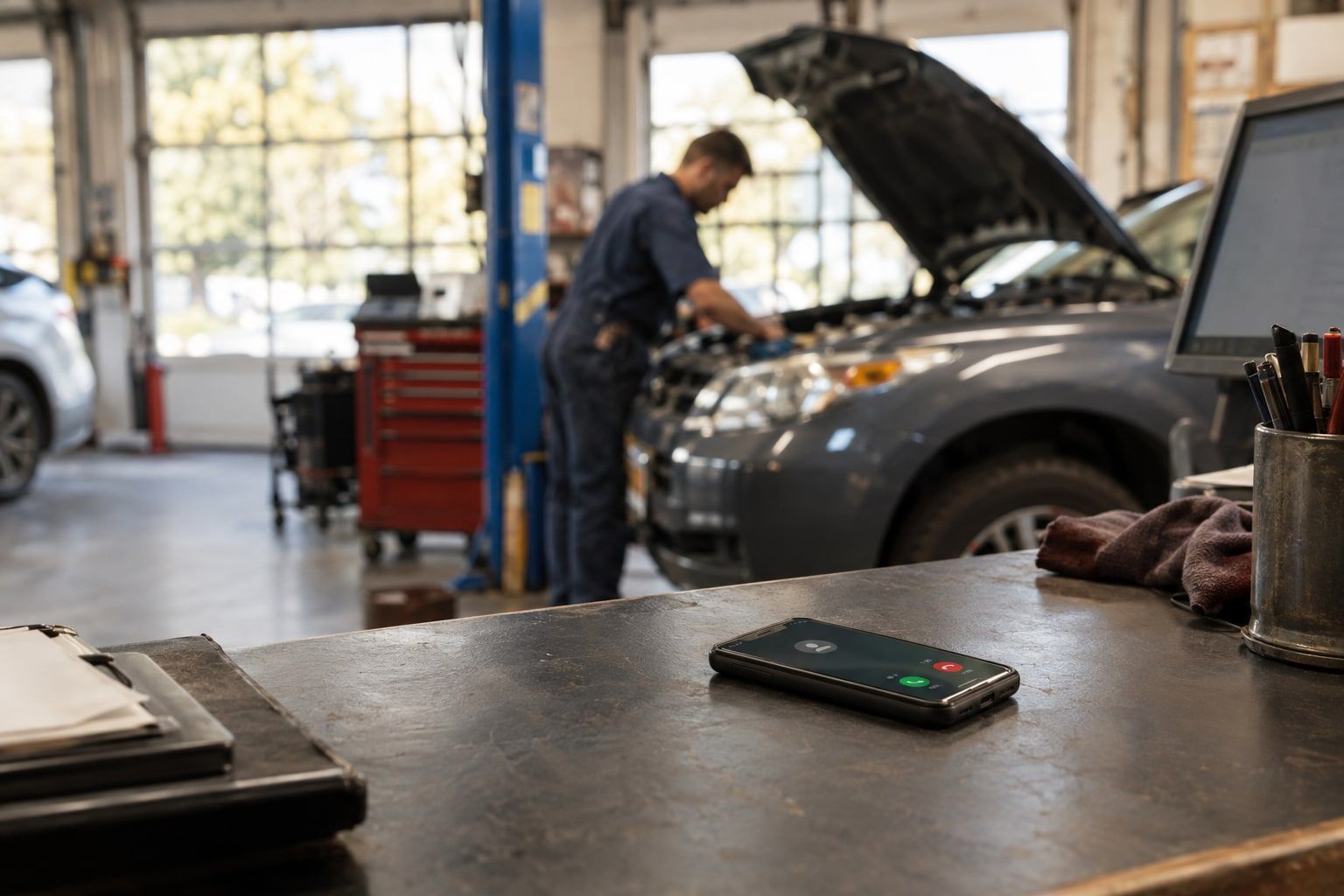
Every small business owner knows the feeling: you’re on a roof, under a sink or in a showing, and the phone buzzes in your pocket. You’ll call back later. Will they pick up? This page pulls together the research on how often business calls go unanswered, why customers still call, how people treat unknown numbers and voicemail, and what that means for how you cover the phone.
How we built this list: we only include figures we could trace to the original source, and each one links to it. Independent research (Pew Research Center, the FTC, CTIA) comes first. Studies by vendors that sell call tracking, caller ID or texting software are labeled as vendor research, and we only included vendor studies that describe how they collected their data. Last checked October 2026.
How often business calls get answered
There is surprisingly little public, well-documented data on missed calls. The largest dataset we found that states its method comes from a call-tracking vendor.
- 56% of inbound calls to businesses were answered by a person; for calls longer than 15 seconds the figure was 65%, and for calls over 30 seconds 71% — Invoca (vendor data, 2026, more than 70 million calls across 10 industries, averages across Invoca’s customers)
- 38% of answered calls were sales leads, and 42% of those leads converted on the call — Invoca (vendor data, 2026)
- In home services, 52% of inbound calls were answered by a person, ranging from 32% to 74% across sub-industries such as HVAC, plumbing, pest control and lawn and tree care — Invoca (vendor data, 2026)
- 55% of home services businesses didn’t ask phone leads to buy or book the job — Invoca (vendor data, 2026)
Keep in mind that these are averages across companies that pay for call tracking, often larger businesses running paid ads. A one-person contractor may do better or worse.
What this means for your team: if roughly four in ten calls don’t reach a person even at businesses that measure their phones, assume your own answer rate is lower than you think. Measure it for a month. Then work on the two gaps the data points to: calls nobody picks up, and calls that get picked up but end without a booked next step.
Why customers still call
Texting and forms keep growing, but for expensive or urgent jobs, people still want to talk to someone.
- 44% of consumers prefer calling a business when they need help with a purchase, up from 32% in 2022 — Invoca (vendor survey, 2025, n=1,000 US and UK consumers who made a high-stakes purchase in the prior 12 months, conducted by Sago)
- 67% called a business at some point during their buying journey — Invoca (vendor survey, 2025, n=1,000)
- 84% said human connection is important during high-stakes purchases — Invoca (vendor survey, 2025, n=1,000)
- Americans spent more than 2.4 trillion minutes on voice calls in 2024, 30 billion more than the year before — CTIA (2025, annual wireless industry survey covering 2024)
- 43% of consumers phone a business “always or most of the time” when they reach out, close to text at 46% — EZ Texting (vendor survey, 2026, n=959 US consumers)
What this means for your team: a phone call is often your highest-intent lead. Someone calling about a water heater or a listing is ready to talk now, and a missed call hands that moment to whoever answers next. Treat inbound calls like your most valuable form submissions, and route them the same way. Our guide to lead routing covers who should pick up and when.
Unknown numbers and voicemail
When you call a lead back, you’re an unknown number. The data on how people treat those calls is sobering.
- 19% of US adults say they generally answer calls from unknown numbers; 67% don’t answer but check voicemail, and 14% don’t answer and ignore voicemail too — Pew Research Center (2020, n=10,211 US adults, July 13–19, 2020)
- Only 14% of consumers immediately answer a call from a number they don’t recognize; 41% ignore it and wait to see if the caller leaves a voicemail, and 28% reject it immediately — Hiya (vendor survey, 2026, more than 12,000 consumers in the US, Canada, UK, France, Germany and Spain, fielded by Censuswide Dec. 17, 2025–Jan. 2, 2026)
- 73% agree that businesses should identify themselves in caller ID when they call — Hiya (vendor survey, 2026, 12,000+ consumers in six countries)
- Seeing a verified business name (29%) is the single detail most likely to make people answer a business call, followed by seeing that the number isn’t flagged as spam (24%); 20% say nothing would make them likely to answer — Hiya (vendor survey, 2026)
What this means for your team: a callback is not a guaranteed second chance. Most people will screen it and some won’t even listen to the voicemail. Leave a short voicemail that says who you are and what they asked about, then send a text right after so they can see your name in writing. Calling from the same number your customers already know helps too.
Spam calls shape behavior
Customers aren’t screening you personally. They’re screening the flood of scam calls.
- 68% of US adults say they get scam phone calls at least weekly, and 31% get them at least daily — Pew Research Center (2025, n=9,397 US adults, April 14–20, 2025)
- The National Do Not Call Registry held about 258.5 million active registrations as of Sept. 30, 2025, and robocalls made up most Do Not Call violation complaints — Federal Trade Commission (2025, fiscal-year registry data)
- 34% say their overall trust in phone calls has decreased in the past 12 months, while 16% say it has increased — Hiya (vendor survey, 2026, 12,000+ consumers in six countries)
What this means for your team: you can’t fix spam, but you can stop looking like it. Call leads back quickly while they still expect to hear from you, and pair calls with a text or email that names your business. And only call or text people who asked to hear from you; our TCPA-friendly texting guide covers the basics (general information, not legal advice).
Text back after a missed call
Texting data from vendor surveys suggests a text can rescue a conversation a missed call would lose.
- 42% of respondents said phone calls are the channel they ignore most, versus 8% for SMS — Textmagic and Pollfish (vendor survey, 2025, n=1,800 US adults, March 2025)
- 30% say they texted a business and got no reply — Textmagic and Pollfish (vendor survey, 2025, n=1,800)
- 70% expect a business to reply to a text within one hour — EZ Texting (vendor survey, 2026, n=959)
- For customer questions, 33% prefer texting and 18% prefer phone calls — SimpleTexting (vendor survey, 2026, n=1,000 US consumers, Jan. 7–8, 2026)
What this means for your team: when you miss a call from someone who has agreed to receive texts, a quick “Sorry we missed you, this is Dana from Avery Plumbing. Is this about a repair or a quote?” keeps the lead warm and lets them answer on their own time. Then reply within the hour. For a deeper look at combining both channels, see texting vs calling new leads.
People, AI and the phone
AI voice agents can answer when nobody else can, but customers are clear about one condition.
- 67% prefer human support when AI and human options are equally available — Invoca (vendor survey, 2025, n=1,000 US and UK consumers)
- 77% are more willing to use a brand’s AI assistant when they can easily reach a human — Invoca (vendor survey, 2025, n=1,000)
- 74% prefer AI when it resolves their issue faster than a human would — Invoca (vendor survey, 2025, n=1,000)
What this means for your team: use an AI receptionist to cover the gaps (after hours, weekends, when everyone is on a job), not to hide your team. In Exa, the AI receptionist answers inbound calls, qualifies the caller, checks availability and books appointments, then saves the transcript, recording and summary to the lead’s timeline so a person can follow up. Our AI receptionist guide covers scripts, disclosure and handoff to humans.
Popular stats we left out
You’ll see these numbers on many websites. We couldn’t trace them to an original study with a stated method, so they aren’t on this page:
- “85% of people whose calls go unanswered won’t call back.”
- “80% of callers sent to voicemail don’t leave a message.”
- “62% of calls to small businesses go unanswered.” This is often credited to a 411 Locals study reported around 2016; we couldn’t open the original report.
- Dollar figures for what missed calls cost a “typical” small business per year.
They may be directionally right, but you don’t need them. The traceable data above makes the same point.
Final thoughts
The verified research points one way. A large share of business calls never reach a person, the people calling are often your most motivated leads, and once you miss them, spam-weary customers make it hard to reconnect by phone alone.
You don’t need a call center to fix this. Measure how many calls you miss, decide who covers the phone during busy hours, follow every missed call with a named text where you have consent, and use an AI receptionist for the hours nobody can pick up. If you work in the trades, our contractors page shows how this fits a typical day in the field.
Try it with your own leads
Exa puts leads, pipeline, inbox and an AI assistant in one simple app.
Sources
- Invoca — Lead Conversion Benchmarks Report 2026 (2026)
- Invoca — Home Services Lead Conversion Benchmarks Report 2026 (2026)
- Invoca — B2C buyer experience study press release (2025)
- CTIA — 2025 Annual Survey press release (2025)
- Pew Research Center — Most Americans don't answer cellphone calls from unknown numbers (2020)
- Hiya — State of the Call 2026 (2026)
- Pew Research Center — Online Scams and Attacks in America Today (2025)
- Federal Trade Commission — Annual Do Not Call Registry Data Book press release (2025)
- Textmagic and Pollfish — State of Business Texting 2025 (2025)
- EZ Texting — 2026 Consumer Texting Behavior Report (2026)
- SimpleTexting — Texting and SMS Marketing Statistics (2026)
FAQ
Frequently asked questions
Short answers to the questions we hear most about this topic.
Still have questions?
Start a free trial and see Exa with your own leads and pipeline, or email our team.
What percentage of calls to businesses go unanswered?
In Invoca's 2026 benchmarks, based on more than 70 million calls tracked for its customers, 56% of inbound calls were answered by a person, which implies the rest were not. Answer rates were higher for longer calls, which filters out misdials and quick hang-ups.
Is it true that 85% of callers who reach voicemail never call back?
We could not find an original study with a stated method behind that number, so we don't use it. The traceable research shows something related: most people screen unknown calls and many ignore voicemail, so a missed call is hard to recover.
Do customers still prefer to call businesses?
For complex or expensive purchases, many do. In Invoca's 2025 survey of 1,000 US and UK consumers who made a high-stakes purchase, 44% said calling is their preferred way to get help and 67% had called a business during their buying journey.
Why don't leads answer when I call them back?
Most people screen calls from numbers they don't recognize. Pew found that 80% of US adults don't generally answer unknown numbers, and Hiya's 2026 survey found that a verified business name is the single detail most likely to get people to pick up.
Should an AI receptionist answer missed calls?
It can help cover after-hours and busy periods, as long as callers can still reach a person. In Invoca's 2025 survey, 77% of consumers said they are more willing to use a brand's AI assistant when they can easily reach a human.
Recommended reading
AI receptionist: answer every call, qualify and book
How AI voice receptionists work, what they handle well, scripts and qualification questions, disclosure and recording consent, and handoff to people.
7 min readRead
Lead response time statistics: how fast is fast enough?
What the research actually says about responding to new leads, from the 2007 MIT/InsideSales study to 2025 audits, with each study's year, sample and limits.
8 min readRead
Texting vs calling new leads: which works better?
When to call and when to text new leads, a combined first-hour sequence, the consent and quiet-hours basics, and how to measure which works for you.
6 min readRead
AI voice agents for small business: a buyer's guide
Inbound vs outbound AI voice agents, where they help small businesses, what to test before you buy, the FCC rules on AI voices and the costs to plan for.
6 min readRead